
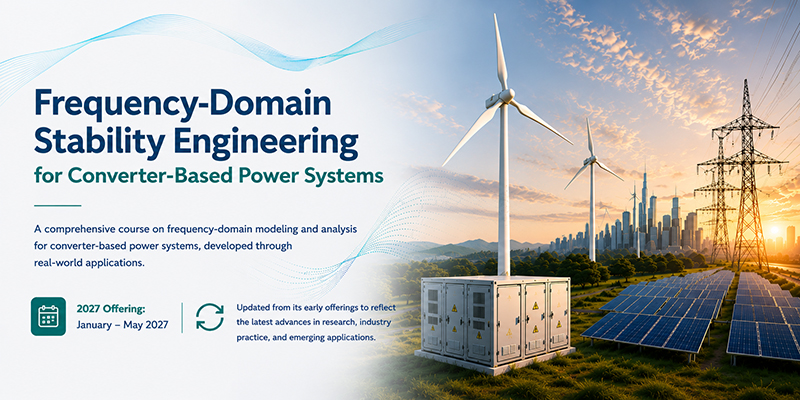
Learning the Practice of Frequency-Domain Stability Engineering
Modern converter-based power systems present stability challenges that span multiple physical domains, multiple frequency ranges, and multiple levels of system complexity. Addressing these challenges requires more than individual analytical techniques—it requires a systematic engineering methodology.
This course develops that methodology through a structured progression from component modeling to system-level analysis and finally to practical engineering design.
The Learning Journey
The course follows four stages.

Stage 1 —
Modeling
Represent converters, electrical machines, loads, and networks in the frequency domain.
Outcome:
Develop accurate frequency-domain models suitable for stability studies.

Stage 2 —
System Analysis
Assemble component models into system-level models for AC, DC, and hybrid AC/DC power systems.
Outcome:
Perform stability analysis using Nyquist-based frequency-domain techniques.

Stage 3 —
Engineering Insight
Interpret frequency responses and understand what they reveal about component and system behavior.
Outcome:
Identify the physical origin of instability instead of simply predicting and observing it.

Stage 4 —
Stability Engineering
Connect controller design, damping methods, system architecture, and stability specifications.
Outcome:
Develop practical solutions for real converter-based power systems.
Course Organization
The course is organized into two complementary parts.
Modeling and Stability Analysis
Part I establishes the analytical foundation based on immittance modeling and analysis. Beginning with converter circuits and control, it develops frequency-domain models of converters, generators, loads, and networks before introducing system modeling and stability analysis methods.
By the end of Part I, participants will understand how to construct system models and perform frequency-domain stability studies for AC, DC, and hybrid AC/DC power systems.
- Circuits and Control of Converters
- Frequency-Domain Modeling of Converters
- Modeling of VSC without DC Bus Dynamics
- Modeling of VSC with DC Bus Dynamics
- Immittance Modeling by Frequency Scan
- Modeling of Generators and Grid-Forming Converters
- Stability at Converter-Grid Interface
- Stability with Grid-Following and Grid-Forming Converters
- Stability of DC and Hybrid AC-DC Systems
Stability Engineering in Practice
Part II focuses on engineering applications of immittance-based frequency-domain modeling and analysis. Building on the analytical framework established in Part I, it explains how converter control, electrical networks, and system architecture interact to produce oscillations and instability, and practical methods to solve these problems.
Emphasis is placed on engineering insight developed through practical examples drawn from renewable energy systems, HVDC transmission, data center power systems, and other converter-based power systems.
- Immittance Responses and Effects of Control
- PV Inverter and Wind Turbine Immittances
- HVDC Converter Immittances
- High-Frequency Instability – Modes and Root Causes
- High-Frequency Instability – Solutions
- Low-Frequency Instability – Modes and Root Causes
- Low-Frequency Instability – Solutions
- Multi-Converter System Instability
- Stability-oriented converter and system design
A Different Kind of Course
Many courses teach converter modeling. Others focus on power system stability. Still others are devoted to specific systems such as renewable energy, HVDC transmission, or battery energy storage. This course integrates these subjects into a unified and comprehensive engineering framework for converter-based power systems. Participants will not only learn the underlying theory but also develop the engineering judgment needed to interpret frequency-domain behavior, diagnose instability, and design robust converter-based power systems.
